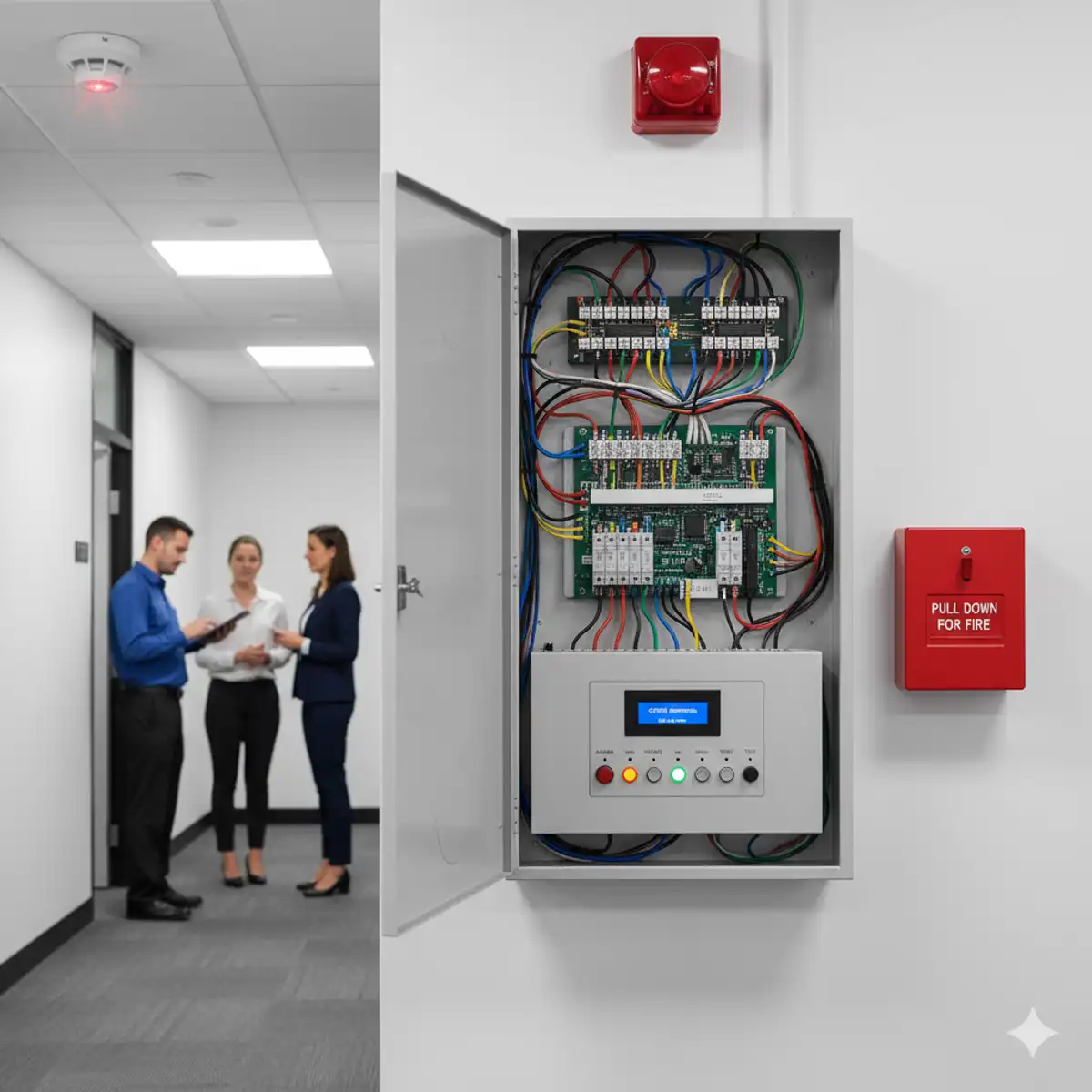
When most people think about a fire alarm, they picture a red box on the wall or a loud siren that interrupts the working day. Simple enough. But behind that familiar sound is a carefully designed network of devices working together to detect danger, alert occupants, and support a safe evacuation.
Commercial fire alarm systems are far more sophisticated than many people realise. They continuously monitor buildings for signs of fire, communicate with multiple safety systems, and provide critical information that can help save lives and reduce property damage.
Whether you’re responsible for an office, warehouse, retail premises, school, healthcare facility, or industrial site, understanding how commercial fire alarms work can help you make informed decisions about fire safety and compliance.
Why Commercial Fire Alarm Systems Are So Important
Fire can spread incredibly quickly.
In many cases, smoke poses a greater immediate threat than flames. Occupants may have only minutes—or even seconds—to react safely before escape routes become compromised.
The purpose of a commercial fire alarm system is straightforward: to detect fire at the earliest possible stage, alert building occupants, support safe evacuation, help emergency services respond quickly, and minimise damage to property and assets.
Without an effective detection and warning system, a small fire can escalate into a major emergency before anyone is aware of the danger.
This is why fire alarms form a fundamental part of a building’s overall fire safety strategy.
The Main Components of a Commercial Fire Alarm System
A fire alarm system consists of several interconnected components, each with a specific role to play.
Fire Detectors
Detectors are the devices responsible for identifying signs of fire.
Depending on the environment, they may detect smoke particles, heat increases, flames, or combustion gases.
Detectors are strategically positioned throughout the building to provide the earliest possible warning.
Fire Alarm Control Panel
The control panel acts as the central hub of the entire system.
Every detector, manual call point, sounder, and interface device communicates with the control panel.
When a detector identifies a potential fire, the control panel receives the signal, processes the information, and activates the appropriate response.
Modern control panels can provide detailed information about alarm locations, system faults, device status, evacuation zones, and maintenance requirements.
Sounders and Visual Warning Devices
Once a fire is detected, the system activates warning devices throughout the building.
These may include sirens, bells, electronic sounders, voice evacuation systems, and flashing beacons.
Visual indicators are particularly important in noisy environments and for supporting occupants with hearing impairments.
Manual Call Points
Manual call points allow building occupants to raise the alarm if they discover a fire before automatic detectors activate.
These are the familiar red units often positioned near exits and along escape routes.
When activated, they immediately notify the control panel and trigger the alarm system.
Backup Power Supplies
Commercial fire alarms must remain operational even during a power failure.
Most systems include backup batteries capable of maintaining operation for extended periods if mains power is lost.
In larger facilities, fire alarm systems may also be supported by standby generators.
How Fire Detectors Identify Danger
Different environments present different fire risks, which is why various detector technologies exist.
Smoke Detectors
Smoke detectors are among the most common fire detection devices.
They are designed to identify smoke particles in the air before flames become visible.
There are two main types:
Optical Smoke Detectors
Optical detectors use a light source and sensor.
When smoke enters the chamber, the light pattern changes and triggers an alarm.
These detectors are particularly effective at detecting slow-smouldering fires.
Ionisation Smoke Detectors
Ionisation detectors respond to smaller smoke particles produced by rapidly developing fires.
Although less common in many modern commercial applications, they remain effective in certain environments.
Heat Detectors
Heat detectors activate when temperatures rise beyond a predetermined threshold.
They are commonly used in areas where smoke detectors may generate false alarms, such as kitchens, boiler rooms, workshops, and dusty industrial environments.
Flame Detectors
Flame detectors identify specific wavelengths of light produced by flames.
They can respond extremely quickly and are often used in higher-risk industrial settings.
Multi-Sensor Detectors
Many modern systems combine multiple detection methods into a single device.
By analysing both smoke and heat, multi-sensor detectors can improve accuracy and reduce false alarms.
What Happens When a Fire Is Detected?
When a detector identifies a potential fire, the process happens remarkably quickly.
Step 1: Detection
A detector senses smoke, heat, flames, or another indicator of fire.
Step 2: Signal Transmission
The detector sends a signal to the control panel.
Step 3: Verification and Processing
The control panel analyses the incoming signal and determines the appropriate response.
Step 4: Alarm Activation
Sounders, beacons, or voice evacuation systems activate throughout the designated areas.
Step 5: Additional Safety Measures
Depending on the building, the fire alarm system may also release fire doors, activate smoke control systems, shut down air handling equipment, trigger sprinkler systems, or notify remote monitoring centres.
Step 6: Emergency Response
Occupants begin evacuation procedures while emergency services are contacted where necessary.
The entire sequence may take only seconds.
Conventional vs Addressable Fire Alarm Systems
Commercial buildings typically use one of two system types.
Conventional Fire Alarm Systems
Conventional systems divide a building into zones.
When a detector activates, the control panel identifies the affected zone but not the exact device.
For example, the panel may indicate:
“First Floor East Wing”
rather than identifying the precise detector.
Advantages include lower installation costs, simpler operation, and suitability for smaller premises.
Addressable Fire Alarm Systems
Addressable systems assign a unique electronic address to every detector and device.
When an alarm activates, the control panel can identify the exact location.
For example:
“Warehouse A – Aisle 4 – Detector 27”
Benefits include faster incident response, easier fault finding, improved maintenance, greater flexibility, and better scalability.
Addressable systems are commonly used in larger commercial buildings, schools, hospitals, and industrial facilities.
Wired and Wireless Fire Alarm Systems
Modern fire alarm systems can communicate using either wired or wireless technology.
Wired Systems
Traditional wired systems use dedicated fire-resistant cabling to connect devices.
Advantages include high reliability, stable communication, and long-term durability.
Many wired systems are installed in loop configurations so signals can continue travelling even if part of the cable becomes damaged.
Wireless Systems
Wireless systems use radio communication between devices.
Benefits include faster installation, reduced disruption, and greater flexibility during refurbishments.
However, wireless devices require battery management and regular monitoring.
Both approaches can provide excellent protection when properly designed and maintained.
Fire Alarm Integration with Other Safety Systems
Modern fire alarms rarely operate in isolation.
Many systems integrate with wider building safety infrastructure.
These integrations may include fire doors that automatically close to slow the spread of smoke and flames, smoke control systems that remove smoke from escape routes and improve visibility, emergency lighting that supports evacuation, access control systems that unlock doors to provide safe exit routes, and sprinkler systems that provide automatic fire suppression.
This coordinated approach significantly improves overall fire protection.
Designing a Commercial Fire Alarm System
Effective fire alarm design involves far more than placing detectors around a building. Fire alarm designers consider factors such as building layout, occupancy levels, fire risks, escape routes, ceiling heights, airflow patterns, and environmental conditions. For example, a warehouse storing combustible materials requires a very different solution from a modern office building.
System design should always be based on a comprehensive fire risk assessment and relevant British Standards.
The Importance of Testing and Maintenance
Even the most sophisticated fire alarm system can fail if it is not maintained properly. Regular testing helps ensure detectors operate correctly, batteries remain functional, sounders are audible, communication pathways are intact, and faults are identified early. Routine maintenance can also reduce false alarms, improve reliability, and support regulatory compliance.
Professional servicing is essential for ensuring continued performance throughout the life of the system.
Legal Responsibilities for Businesses
In the UK, fire safety legislation places responsibility on the building’s Responsible Person. This may include employers, building owners, landlords, and facilities managers. Responsible Persons must ensure fire detection and warning systems are suitable, maintained, and fit for purpose. Failure to do so can result in enforcement action, fines, and significant liability in the event of an incident.
Why Commercial Fire Alarms Matter
A commercial fire alarm system is far more than a legal requirement. It is a critical life safety system designed to protect people, property, and business continuity. Most of the time, it operates silently in the background, monitoring conditions and waiting for signs of danger. When that moment arrives, every detector, cable, sounder, and control panel component works together to provide the earliest possible warning. Those seconds can make all the difference.
Why Choose RJ Wilson?
At RJ Wilson, we design, install, maintain, and upgrade commercial fire alarm systems for businesses across a wide range of sectors. Our experienced engineers understand that no two buildings are the same. That’s why we take a tailored approach to every project, ensuring systems are designed around the specific risks, layout, and operational requirements of each site. Whether you require a new fire alarm installation, system upgrade, ongoing maintenance contract, or expert advice on compliance, our team can help.
If you’re considering a new commercial fire alarm system or want to ensure your existing system continues to meet current standards, contact RJ Wilson today. We’ll help you create a reliable fire detection solution that protects your people, supports compliance, and provides confidence that your building is prepared for the unexpected.