Securing your business is serious business. Your premises, equipment and staff all rely on a strong security system, and a camera setup that fails isn’t an option. That’s why choosing the right type of commercial security camera matters.
At RJ Wilson, we get asked all the time: should my business go wired, wireless, or even wire-free? It’s not always obvious. There’s more to the choice than just whether a cable runs along the wall.
We’ve broken down the main options for commercial properties to help you make the right decision, and we’ll also touch on the wire-free systems that some people get confused with wireless cameras.
Wired Security Cameras for Businesses
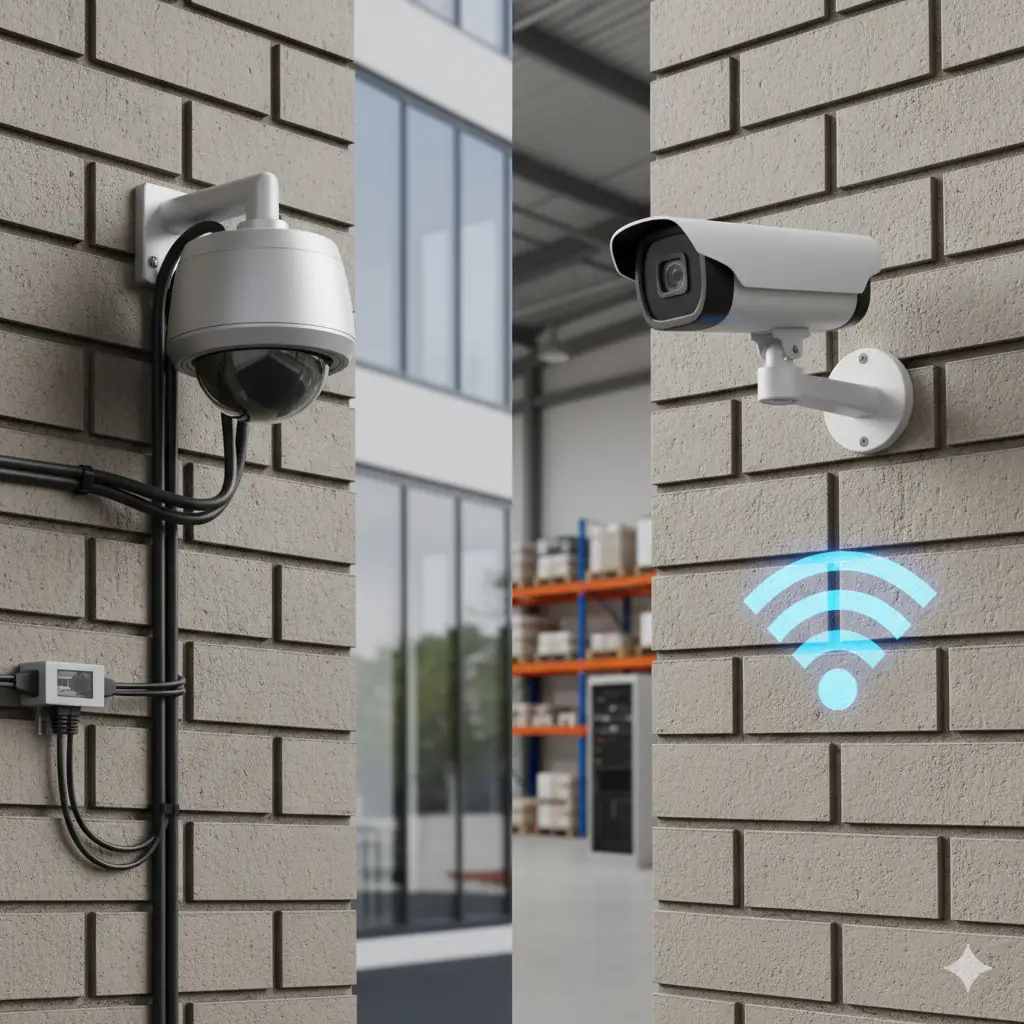
As the name suggests, wired cameras need cables. Not just for power, but also to carry video and data between the camera, the recorder and your network. For larger businesses, warehouses or retail premises, wired systems are usually the safest bet.
How Wired Systems Work
A wired commercial setup generally works in one of two ways:
- Two cables running to each camera; one for power, one for video. Often these come in a single sheath called siamese cable.
- One cable handling both power and video using Power over Ethernet (PoE).
Benefits of Wired Commercial Security
Reliable network
Wired systems aren’t bothered by WiFi interference or signal drop-outs. Hackers and burglars can’t jam them easily. Yes, a wire can be cut, but proper installation hides them out of sight.
Scalable for big businesses
Need dozens of cameras for multiple floors or entrances? Wired systems can handle it without slowing down.
Permanent solution
Once installed, wired cameras become part of the building’s security backbone. You won’t need to move them or worry about battery life.
Drawbacks of Wired Systems
Professional installation needed
Running multiple cables and connecting cameras isn’t a DIY job for most. It can take time, and a botched installation can cause lasting issues.
Power dependence
If the mains go down, so do your cameras. Businesses with backup generators or UPS systems can get around this.
Wireless Security Cameras
Wireless cameras are often pitched as simpler and quicker to set up. They transmit footage via your WiFi network rather than cables, but there’s a catch: the cameras still need a power source.
How Wireless Works
Wireless cameras connect to your network, sending video to a recorder or cloud storage. You can view the feed from a computer or phone.
Benefits for Businesses
Easier to install
No need to run cables across walls or ceilings, which can save time during setup.
Flexible placement
Good for businesses in temporary locations or small offices that might move around in a year or two.
Drawbacks of Wireless Cameras
Prone to interference
Other WiFi networks or electronic equipment can disrupt the signal. In large commercial spaces or multi-storey buildings, connection issues happen.
Not completely cable-free
The cameras still need power, so outages can affect them just like wired systems.
Coverage limits
Distance from your router, walls and metal structures can reduce signal strength. Integration with access controls or alarms is also trickier than with wired systems.
Wire-Free Security Cameras
Wire-free cameras are truly untethered. They run on batteries and don’t need power cables, making them super easy to install. But easy can mean risky in a business environment.
How Wire-Free Cameras Work
Apart from the router needing power, the cameras rely entirely on batteries. Motion detection triggers them to save energy and record when it matters most.
Pros
Quick and simple install
Mount anywhere and move cameras around without rewiring.
Unaffected by power cuts
No mains cable means they keep recording as long as batteries hold out.
Cons
Batteries need charging
Eventually, they will run out, leaving gaps in coverage.
Vulnerable to theft
A simple grab and the camera is gone. Not ideal for retail or commercial properties.
Signal interference
Like wireless cameras, they depend on WiFi and can be affected by nearby signals or jammers.
Our Recommendation
At RJ Wilson, we strongly advise wired security cameras for businesses. Despite longer installation, wired systems provide reliable coverage, minimal downtime and the capacity to integrate with alarms, access control and other security features.
For large commercial sites, warehouses or offices with multiple entrances, only a wired system can give full coverage without compromise.
If you’re unsure what’s best for your business, get in touch with us. We offer free property consultations and practical advice, not pushy sales talk.